

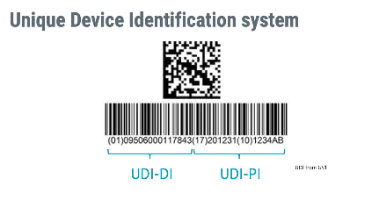
Each health authority creates its own regulations that define UDI and the UDI System, but some parameters have been globally harmonised by the International Medical Device Regulatory Forum (IMDRF) and the standards organisations identified as Issuing Agencies (e.g., GS1, HIBCC, ICCBBA). Some of the common features are below.
UDI is a unique numeric or alphanumeric barcode composed of the following:
Device Identifier (DI): mandatory, fixed portion of UDI that identifies the labeller as well as the specific model or version of the device.
Production Identifier(s) (PI): conditional, variable portion of a UDI that identifies one or more of the following production information:
- Serial number
- Lot or batch number
- Expiration date
- Manufacturing date
Distinct identification code for a human cell, tissue, or cellular and tissue-based product (HCT/P) regulated as a device.
- Example Linear UDI Barcode
- Example 2D Data Matrix UDI Code
A medical device barcode label printer is required to present the UDI on barcode labels and packaging in two formats:
- Human-readable plain-text
- Machine-readable format using automatic identification and data capture (AIDC) technology (e.g., barcode or 2D DataMatrix code)